_________________________________________________________________________
Video by Gerrit Vyn at the Cornell Lab of Ornithology.
home interior design, interior design, interior designer, interior design ideas, interior designers, interior design for home, interior home design, interior design for the home, bedroom designs, home design, living room ideas, ideas for interior design, interior designs, home interiors, interior.
interior design house, house interior design ideas, interior house plans, interior house painting, interior house painting, interior design of a house interior of house, interior of house, interior house designs photos, interior house design, interior house design, interior house ideas, modern house interior
![]() |
| Aerial view of the edge of the sea ice in Nunavut, Canada. Credit: Doc Searls via Wikimedia Commons . |
![]() |
| Credit: National Snow and Ice Data Center. |
Ice age data this year show that the ice cover remains much thinner than it was in the past, with a high proportion of first-year ice, which is thin and vulnerable to summer melt. After the record low minimum of 2007 the Arctic lost a significant amount of older, thicker ice, both from melting and from movement of ice out of the Arctic the following winter. In the last few years, the melt and export of old ice was less extreme than in 2007 and 2008, and multiyear ice started to re-grow, with second and third-year ice increasing over the last three years.
![]() |
| Arctic sea ice. Credit: Pink floyd88 a via Wikimedia Commons. |
![]() |
| Credit: National Snow and Ice Data Center courtesy J. Maslanik and M. Tschudi, University of Colorado. |
![]() |
| Credit: National Snow and Ice Data Center courtesy J. Maslanik and M. Tschudi, University of Colorado. |
![]() |
| Bowhead whale. Via. |
It is not known what attracted the whales to this area, given the region has relatively low marine production in autumn compared with other known bowhead whale feeding areas.
![]() |
| Bowhead whale bones on ceremonial ground, Point Hope, Alaska. Credit: rnoblin via Flickr. |
During the commercial whaling period (i.e. pre-1900), several harpoon heads of Atlantic origin were discovered in bowhead whales harvested in the Chukchi Sea/western Arctic, but this information was largely dismissed as anecdotal by scientists.
Recent genetic studies compared DNA of whales from Foxe Basin, Canada to whales from Alaska and suggest genetic mixing, although results are based on a small sample size from a highly segregated population. The lack of genetic differentiation between whales in the Pacific and the Atlantic, acknowledging that samples are taken several thousand years apart, suggests that some exchange of individuals occurred between whales in Svalbard and Alaska.
![]() |
| Credit: Mads Peter Heide-Jørgensen, et al. Biol Lett. DOI:100.1098/rsbl.2011.0731. |
The Northwest Passage with tracks of four bowhead whales and extent of sea ice with greater than 50% concentration (white fields). (a) Track of a whale tagged on 4 May 2002 in West Greenland and ice extent on 20 September 2002. (b) Track of a whale tagged in Alaska on 12 May 2006 and sea ice extent on 8 August 2006. (c) Track of a whale tagged on 24 May 2010 in Alaska, one tagged on 15 April 2010 in West Greenland, and sea ice extent on 14 September 2010. The insert shows the area where whales occurred together in 2010. The whale from Alaska was present in Viscount Melville Sound between 19 August and 18 September while the whale from Greenland was present from 11 to 28 September.
![]() |
| 1980: Sea ice coverage 1 Nov-31 Jan. Credit: NASA Earth Observatory. |
![]() |
| 2012: Sea ice coverage 1 Nov-31 Jan. Red star marks approximately where the two whales met in 2010. Credit: NASA Earth Observatory. |
Given recent rates of sea ice loss, climate change may eliminate geographical divisions between stocks of bowhead whales and open new areas that have not been inhabited by bowhead whales for millennia (e.g. North of Greenland and north of the Canadian Archipelago).
The documented movements of bowhead whales in the Northwest Passage are perhaps an early sign that other marine organisms have begun exchanges between the Pacific and the Atlantic Oceans across the Arctic. Some of these exchanges may be harder to detect than bowhead whales, but the ecological impacts could be more significant should the ice-free Arctic become a dispersal corridor between the two oceans.
![]() |
| Bear Glacier, Alaska. Via. |
![]() |
| Glacier melt tunnel. Credit: Dook Cook | DougAK via Flickr. |
![]() |
| Glacier Bay, Alaska. Credit: NPS. |
"This study finds that the world's small glaciers and ice caps in places like Alaska, South America and the Himalayas contribute about 0.02 inches per year to sea level rise," said Tom Wagner, cryosphere program scientist at NASA Headquarters in Washington. "While this is lower than previous estimates, it confirms that ice is being lost from around the globe, with just a few areas in precarious balance. The results sharpen our view of land-ice melting, which poses the biggest, most threatening factor in future sea level rise."
![]() |
| Bering Glacier, Alaska. Credit: NASA. |
![]() |
| Greenland melt map by NOAA’s climate.gov team, based on NASA satellite data processed by Jason Box, Byrd Polar Research Center, the Ohio State University. |
The map above shows the difference between the amount of sunlight Greenland reflected in the summer of 2011 versus the average percent it reflected between 2000 to 2006. Virtually the entire ice sheet shows some change, with some areas reflecting close to 20 percent less light than a decade ago.
![]() |
| Melting atop the Greenland ice sheet. Image via The Big Picture. |
![]() |
| Greenland glacier. Credit: Ville Miettinen via Wikimedia Commons. |
![]() |
| Smaller, colder snow crystals, left. Warmed ice crystals, right. Credit: NASA Earth Observatory. |
![]() |
| Ship wake. Credit: Yosemite James via Flickr. |
![]() |
| Offshore wind farm wakes. Via. |
![]() |
| South Georgia Island cloud wake. Credit: NASA. |
![]() |
| Island wakes, Canary Islands. Via Flickr. |
![]() |
| Aircraft turbulence wake. Via. |
![]() |
| Ship track wakes in the clouds, North Pacific. Credit: NASA. |
![]() |
| Comet wake. Credit: NASA via. |
![]() |
| Bioluminescent dolphin wakes. Credit: Ammonite via National Geographic. |
![]() |
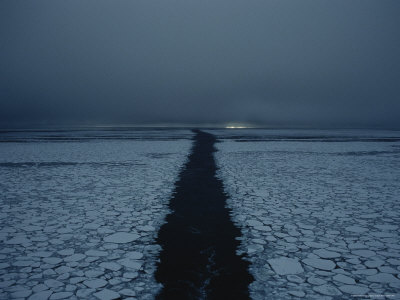
| Icebreaker wake. Via. |
![]() |
| Iceberg wake. Via Wikimedia Commons. |
![]() |
| Crabeater seal wakes, Southern Ocean. Credit: Steve Nicol via. |
![]() |
| Penguin wake. Via. |
![]() |
| Ship bow-wake with bow-riding dolphins. Via. |
![]() |
| Von Karman vortices, Aletian Islands. Credit: USGS. |
![]() |
| Sea turtle wake. Credit: Rosa Say via Flickr. |
![]() |
| Sea turtle wake. Via RedBubble. |
| Surf wake. Via. |
These views of the Arctic are from cigarette cards issued by the Hassan Oriental Cigarette Company between 1900-1917—during the golden age of polar exploration. 


As the supply ship, the Hansa followed the Germania [exploration ship] until July 19, when [Captain Paul Friedrich August] Hegemann misread a flag signal by [captain of the Germania, Carl] Koldeway and went ahead; the ship disappeared in the fog and got separated. The agreement was to meet in such a situation at Sabine Island. After unsuccessful attempts to get there, Hansa was inescapably stuck in the pack ice by mid-September 1869. During the next month, the ship was slowly milled by the ice and finally sank on October 22 at a position 70°32’N, 21°W approximately 10 km from the East Greenland coast. The crew managed to survive the winter in a shelter built of coal dust briquettes, while drifting on the sea ice southward along the eastern coast of Greenland. In June 1870, the crew got to the coast by boat and reached the Moravian Herrnhut mission at Narsaq Kujalleq (then Frederiksdal/Friedrichsthal) near Cape Farewell, from where they got back to Germany on a Danish ship.
Like many panorama and diorama painters of the nineteenth century, when the Arctic was also a popular subject for such entertainments, Operti had a background in theatrical scene painting, and it was with this work that he was chiefly occupied in the middle years of his life, principally with the [New York] Metropolitan Opera. In the last six years of his life he returned to the [American Museum of Natural History], painting diorama backdrops, murals, and friezes for their exhibitions. During this period, he actually lived in quarters provided by the [New York] Explorers Club, and it was there that he died in 1927.